Dismantling Theoretical/Methodological Lens
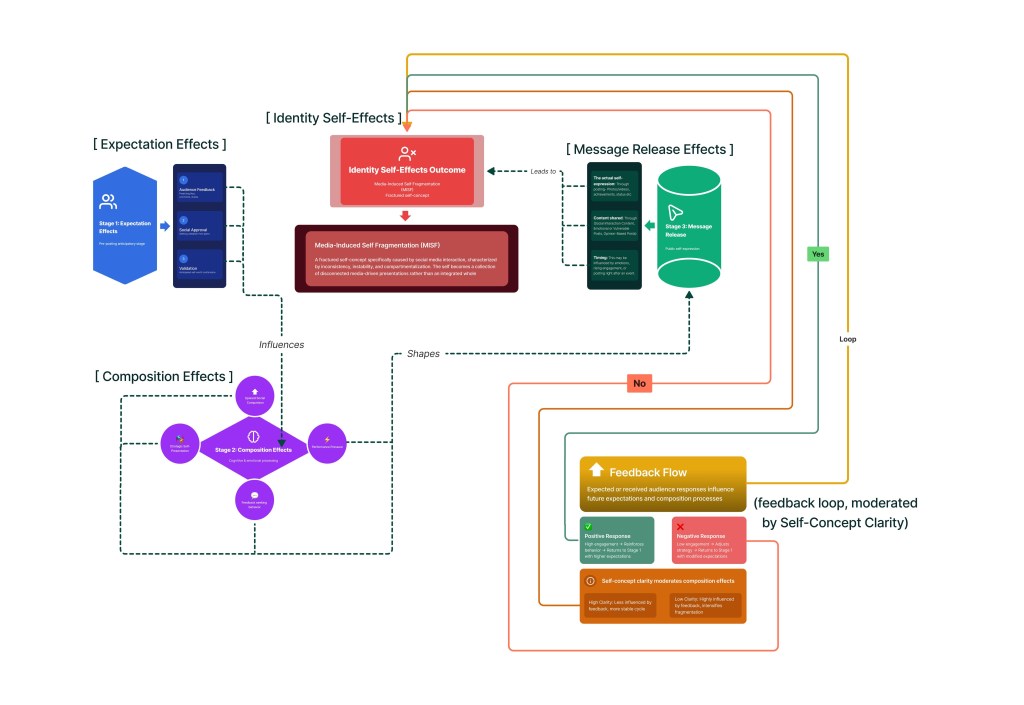
My ”Expression effects self-effects” tree
I am a media effects scholar with a quantitative, STEM‑oriented orientation. I am committed to methodological rigor. In its conventional form, this lens prioritizes individual‑level outcomes, emphasizes internal validity and statistical precision, and often draws on relatively homogenous (frequently Western, educated) samples. That version of “rigor” has trained me well in psychometrics, model testing, and causal inference, but it also carries an implicit assumption that context, power, and structural conditions are secondary or “noise” rather than central to media effects.
My current positionality dismantles that assumption. I retain quantitative media psychology as my home, but I no longer treat it as theoretically neutral or context‑free. Instead, I view “rigor” as incomplete when it brackets off questions of whose experiences are modeled, which identities are centered, and how platform architectures, cultural norms, and structural inequalities shape both media exposure and outcomes. Rather than abandoning quantitative methods, I intend to use them to test more critical, intersectionally informed questions: for whom do certain media pathways hold, under what social and structural conditions, and with what implications for equity and well‑being? That means designing models where race, gender, class, disability, and global location are not mere control variables but core moderators and grouping structures; where group‑level processes (friends’ attributions, peer norms, platform cultures) are built into the model; and where constructs like self‑fragmentation, responsiveness, and belonging are defined in collaboration with the communities most affected.
Dismantling the lens, for me, is not rejecting the language of fit indices, factor loadings, and standardized paths; it is rejecting a narrow definition of objectivity that obscures power. I want my quantitative work to be explicit about how media systems privilege some identities and harm others, and to use advanced methods: multi‑group SEM, invariance testing, moderated mediation, multilevel models, to make those dynamics visible rather than treating them as unmodeled context. In this sense, my theoretical and methodological lens is a hybrid: media effects/media psychology in form, but critical, intersectional, and relational in content. I see that hybridity as the intellectual “home” from which my future scholarship will grow.

